Black Friday week
📄 Digital book in PDF · read it on your phone or print it
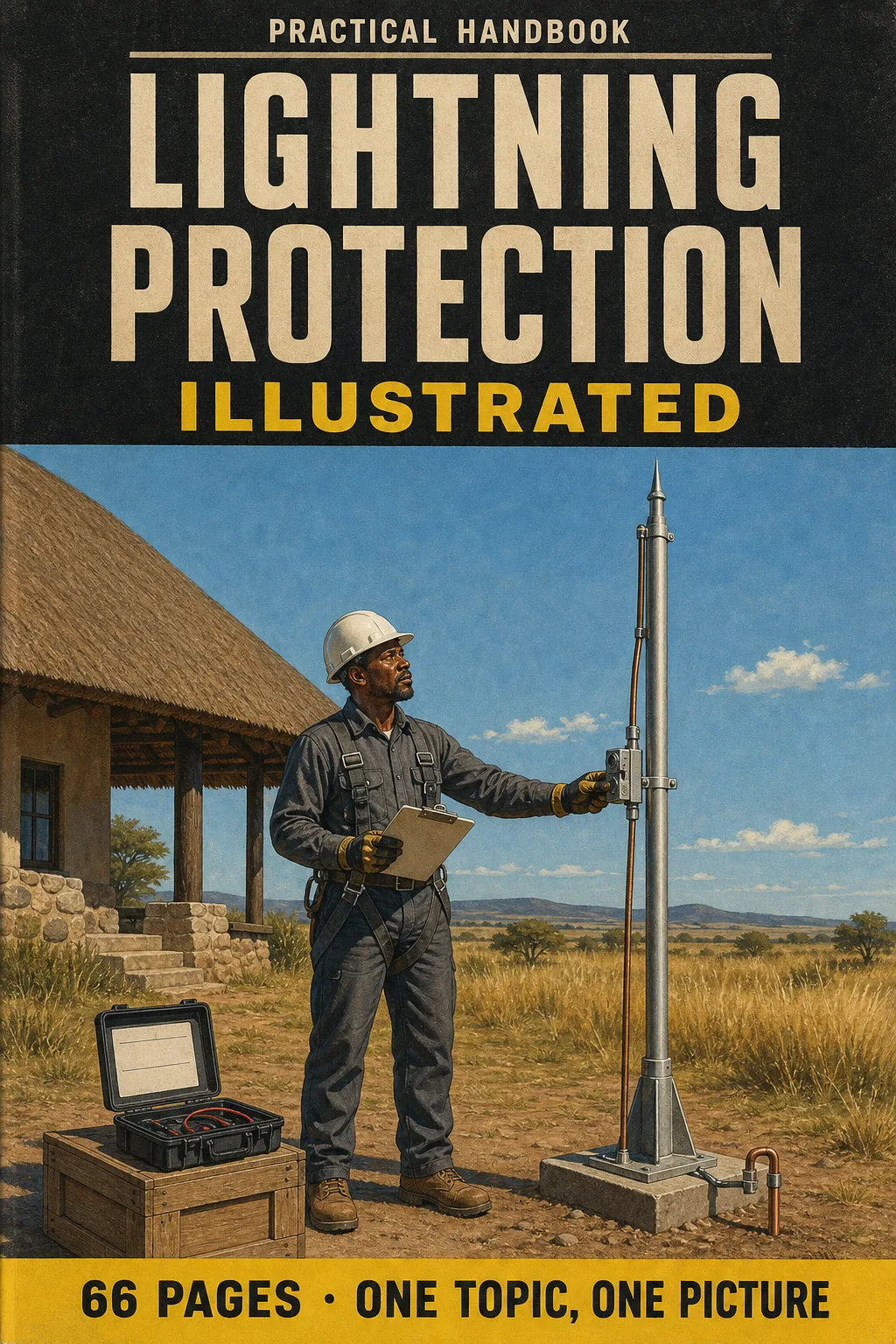
From air terminal to earth electrode, in the order the strike travels, thatch roofs included. Every topic has its own page: the drawing first, then the numbers you need on site. 66 illustrated pages.
🔒 Secure checkout · PDF by email · 30-day guarantee
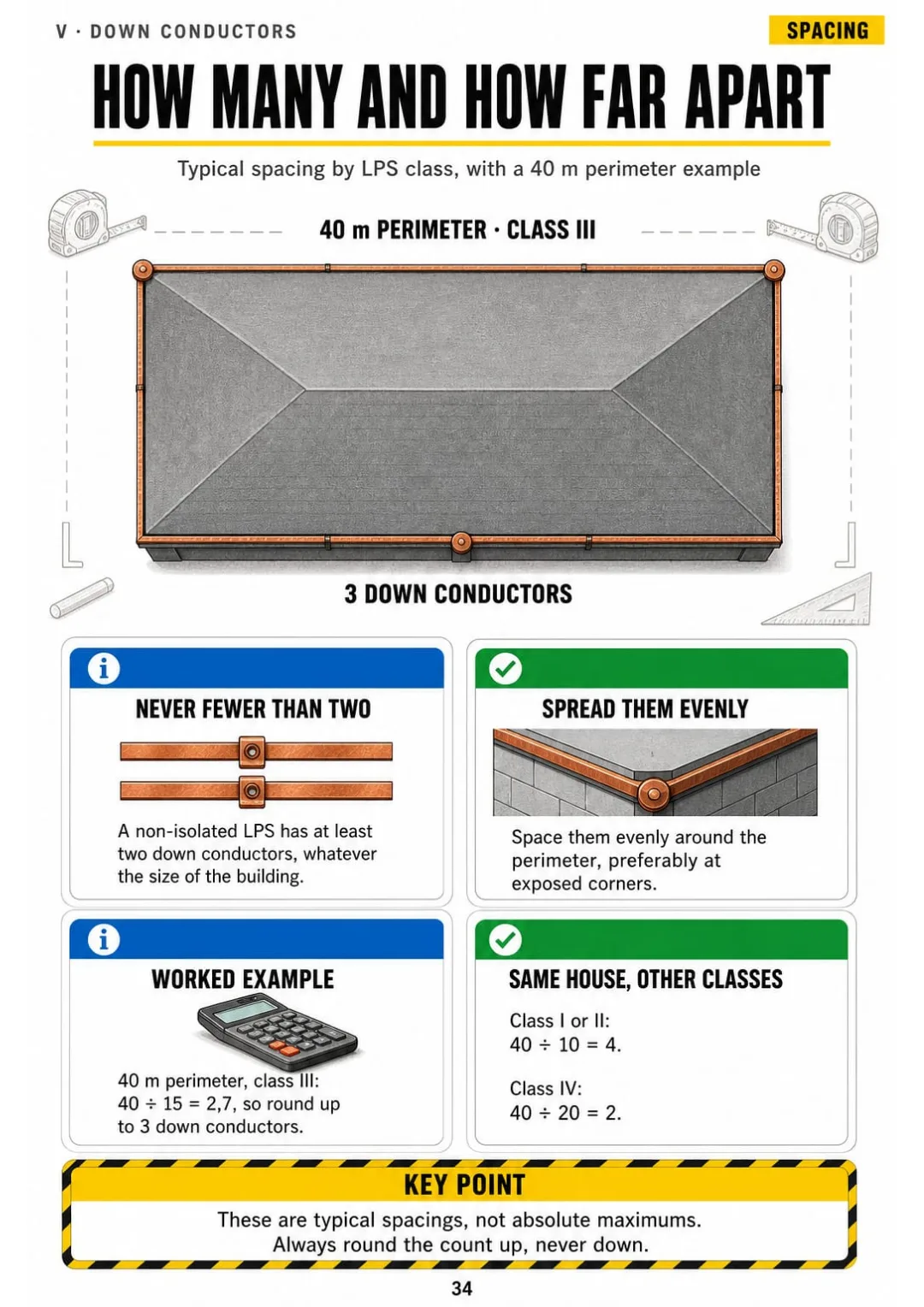
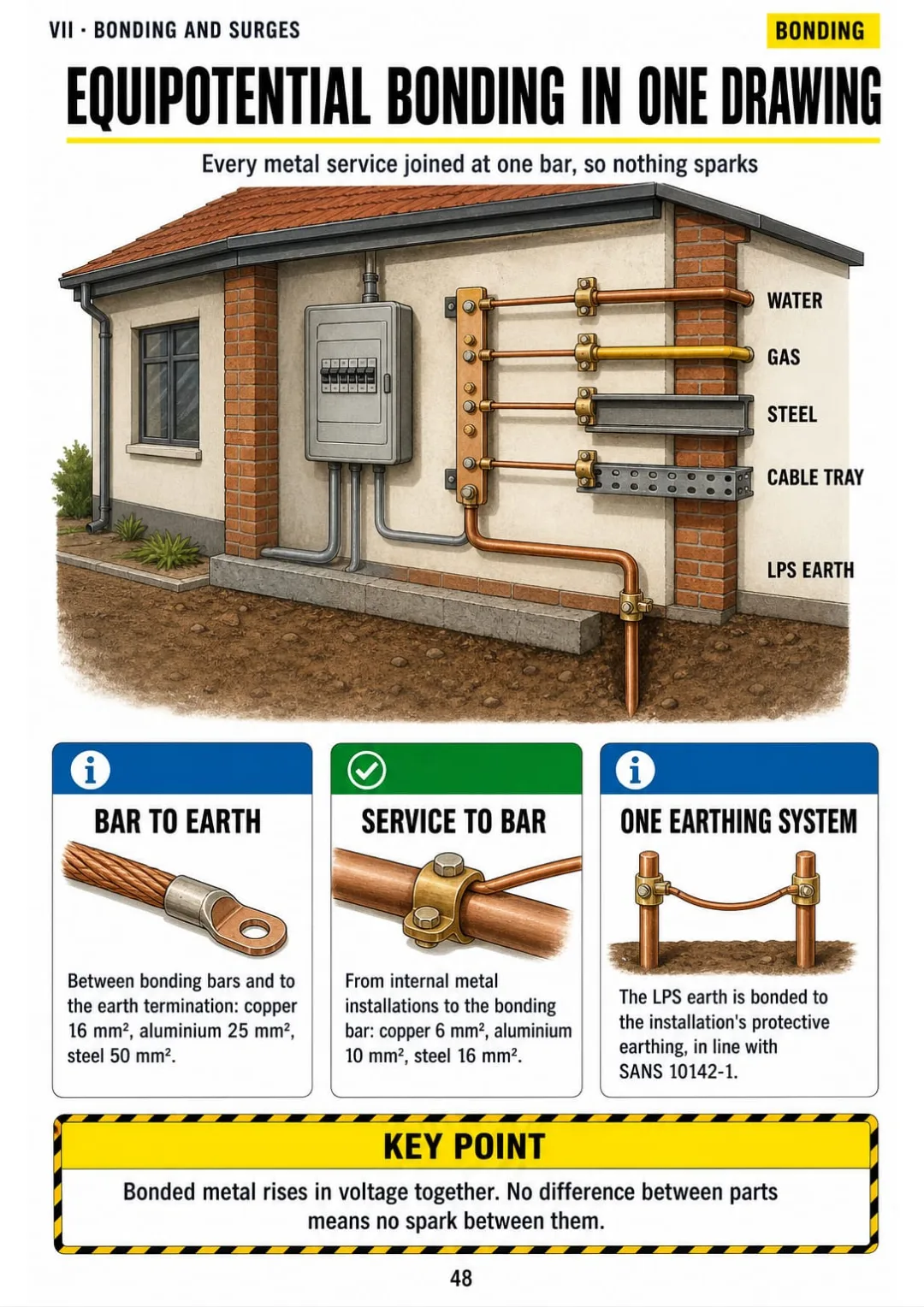
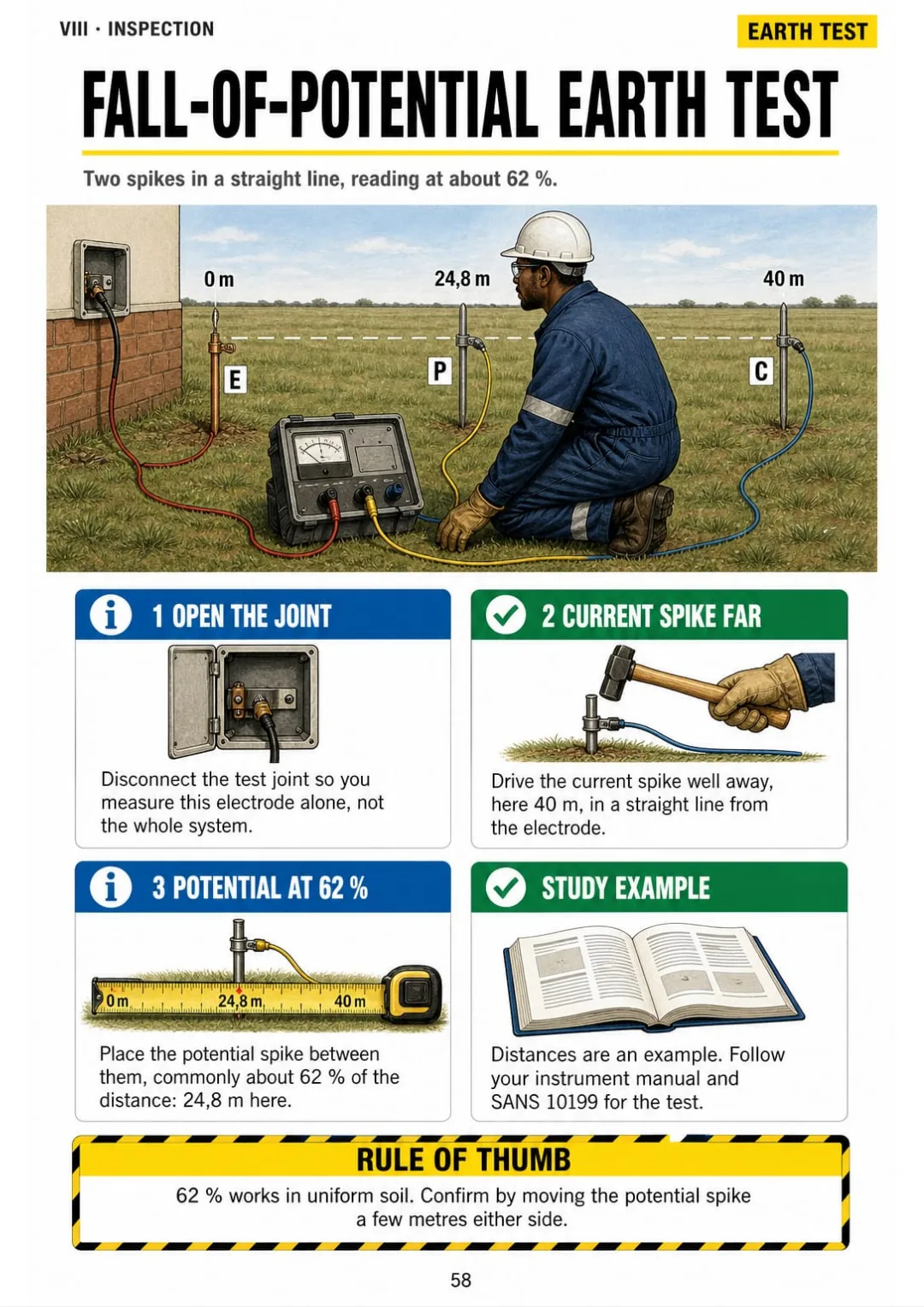
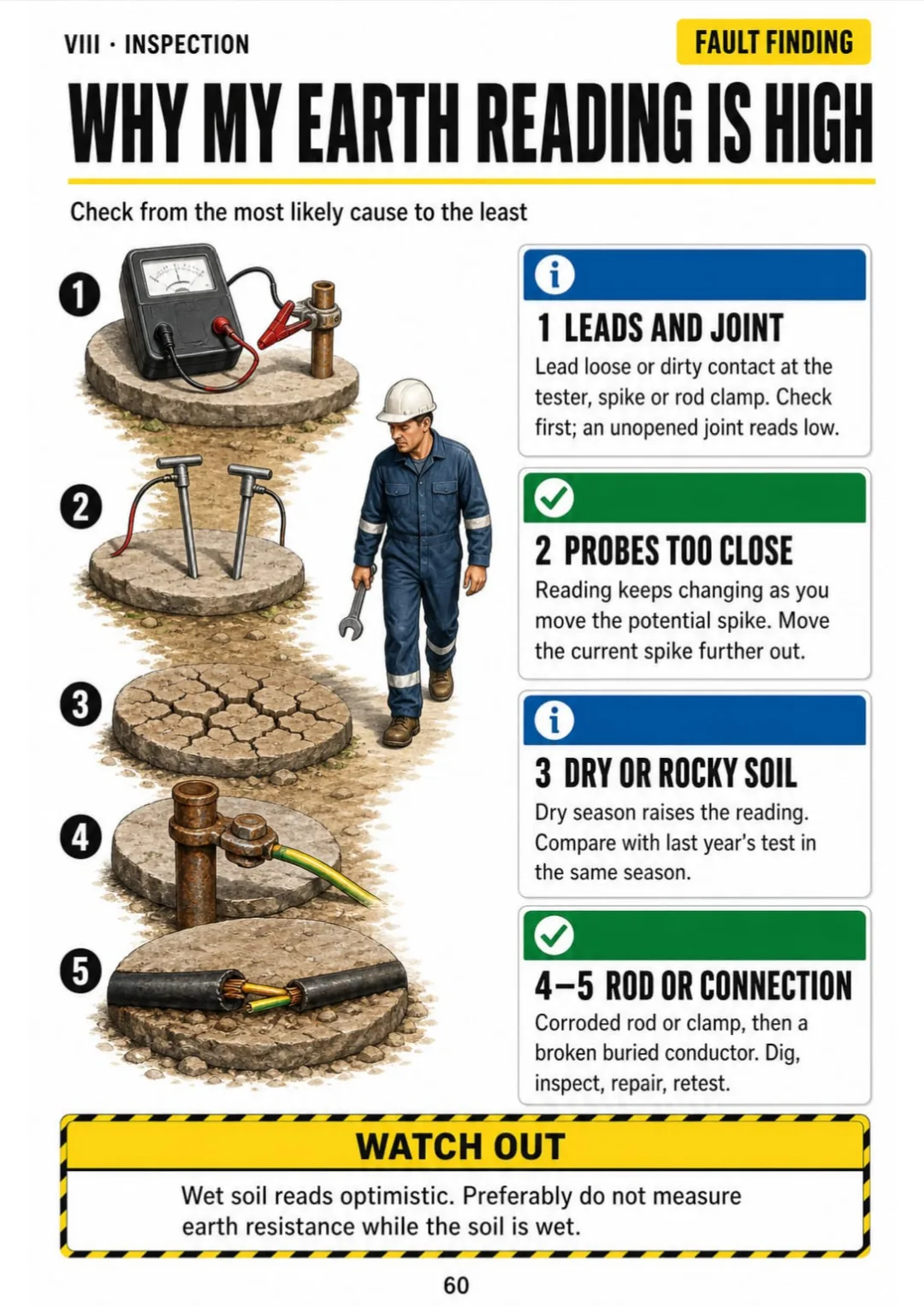
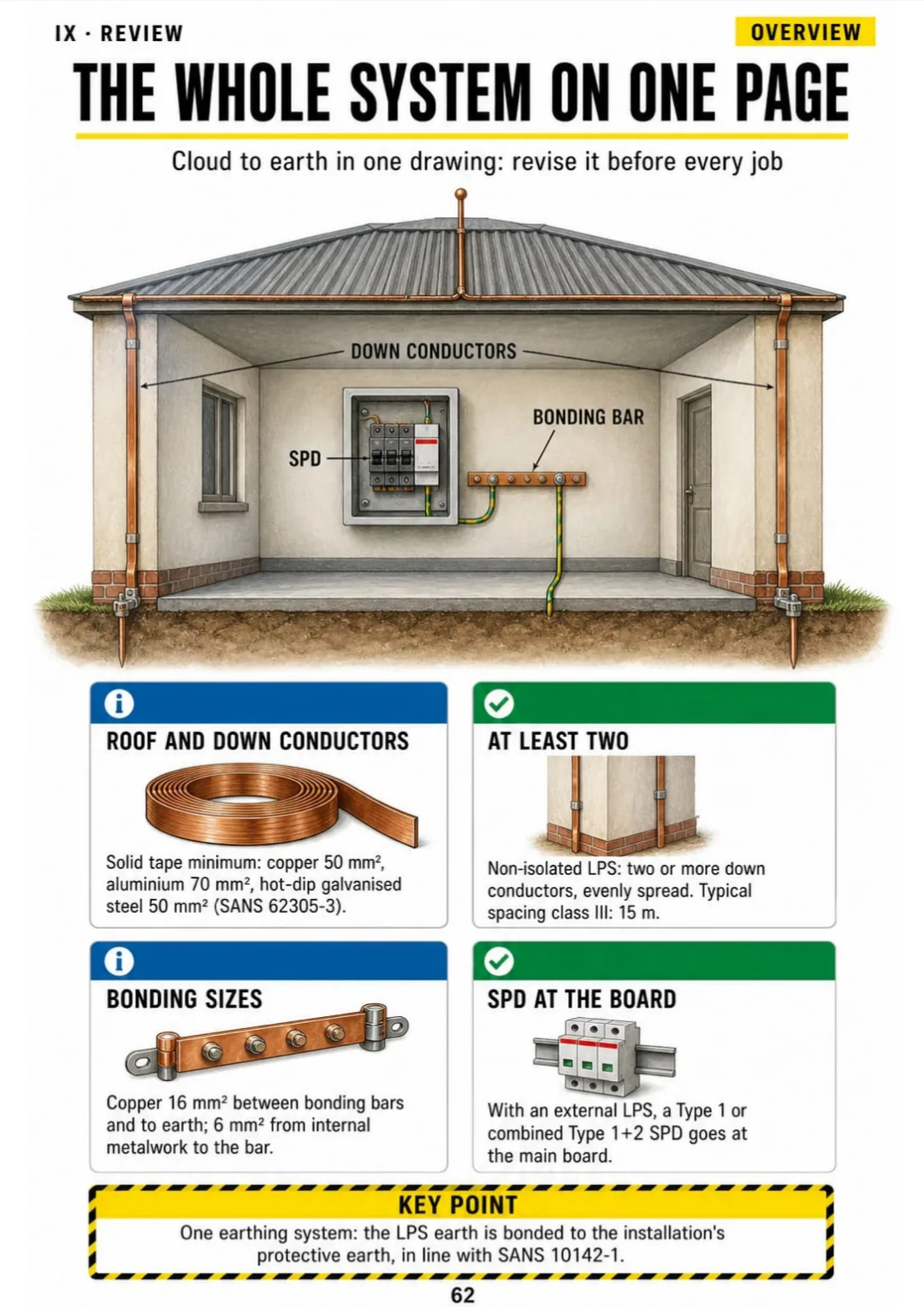
Every page has one large drawing and a box with the distances, sizes and test steps you need to know:


Swipe to see more →
These are real pages from the book. The table of contents is the full one: 9 parts and 62 topics.
You're standing under a thatched lodge with the owner. He points at the mast and asks how far it has to stand from the thatch. He wants a number, not 'far enough'.
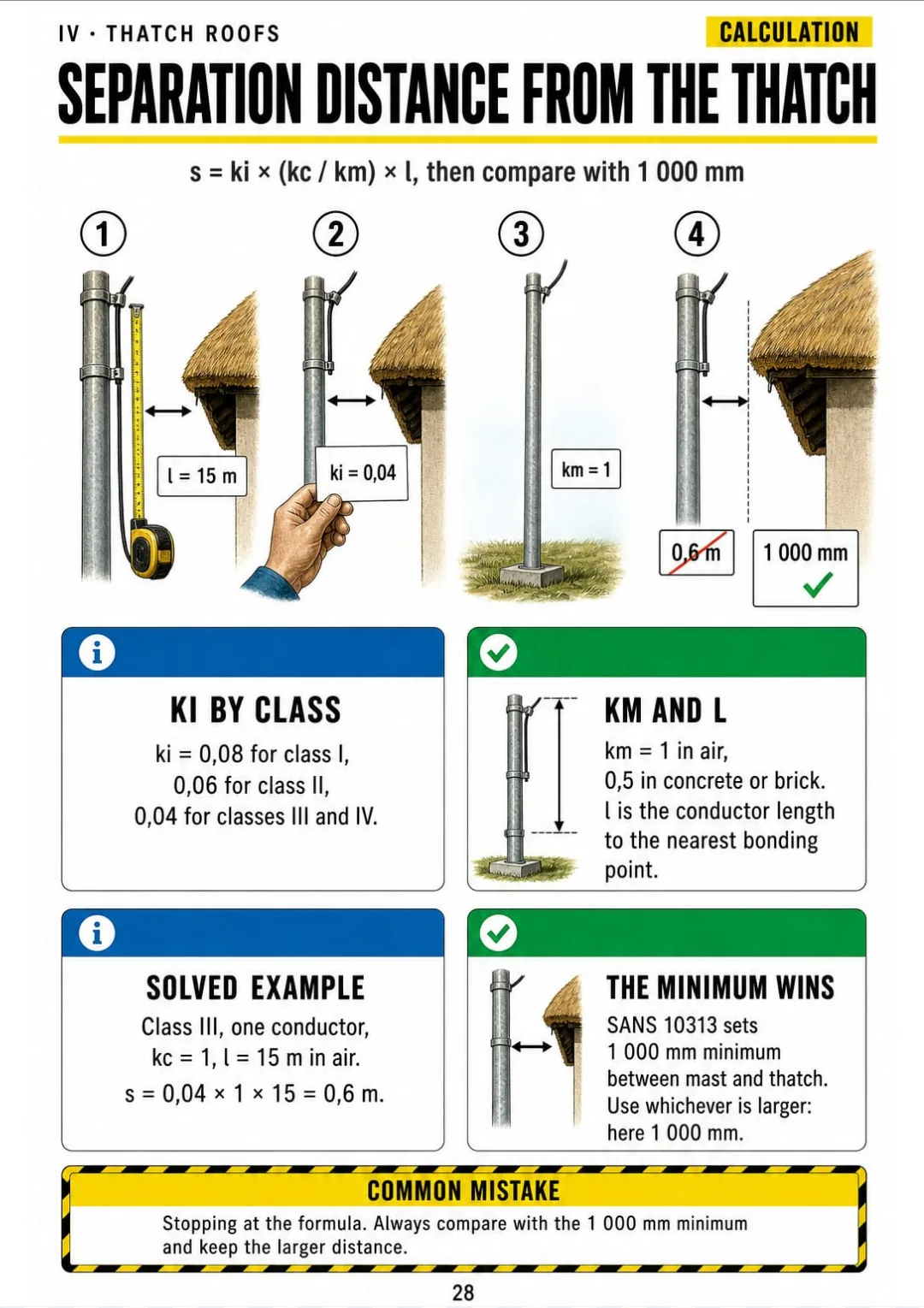
The standard gives you s = ki × (kc/km) × l and a few paragraphs on what each factor means. On paper it's letters and coefficients, not a mast next to a roof. So on site, nothing comes back.

In the book it's one page: the thatch in side view, the mast, the stays and the gap between them, with the example worked out. The formula gives 0,6 m, but the 1 000 mm minimum wins, and you can see why.
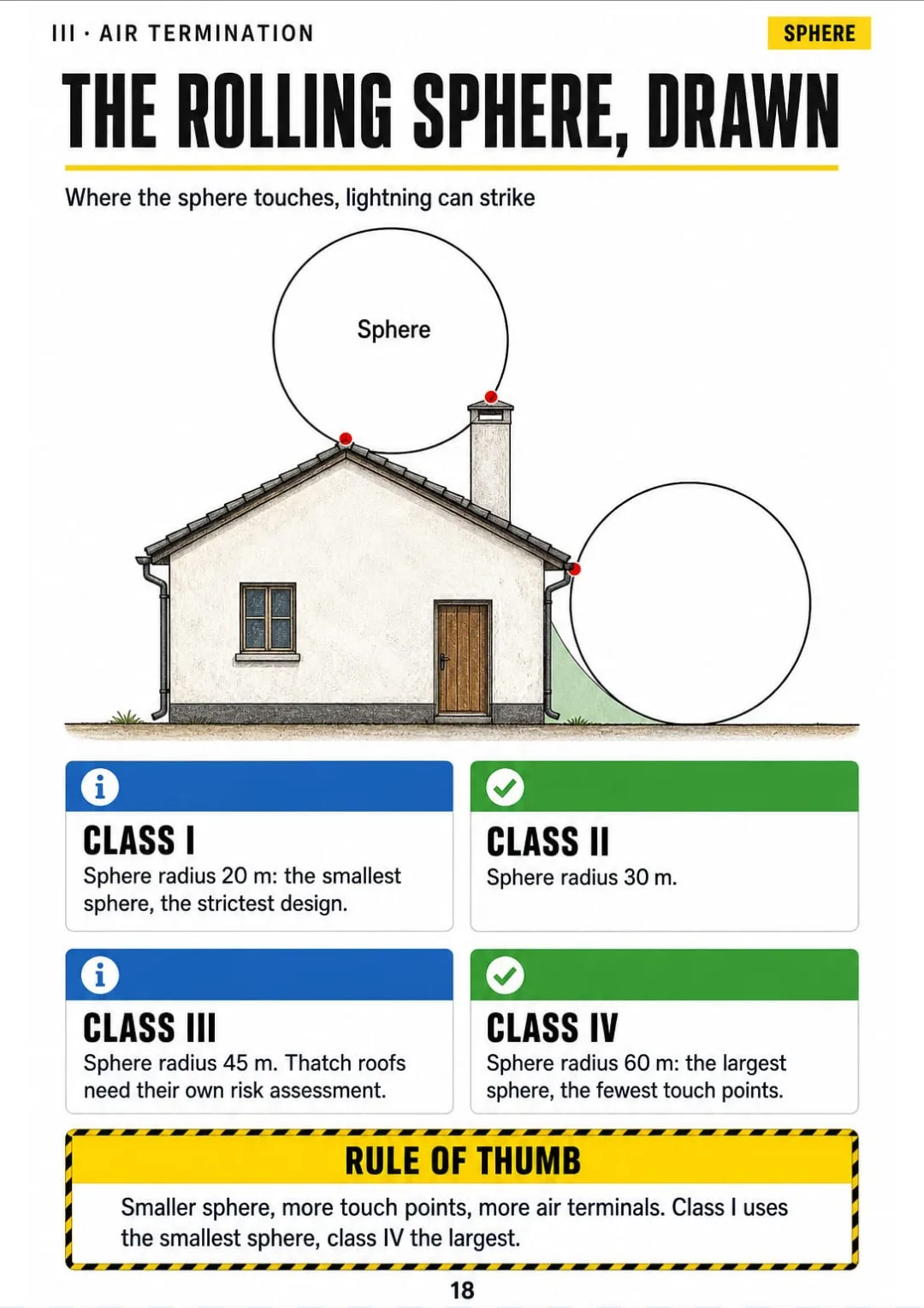
The rolling sphere, down conductor spacing, the test joint, the fall-of-potential test and a high earth reading work the same way: each one has its own page.
You get it, you explain it to the owner, and the standard becomes the check, not the puzzle.

How lightning finds a building, risk and protection level, air termination, thatch roofs, down conductors and test joints, earth termination, bonding and surge protection, inspection and testing, and a final review: 66 pages, all illustrated.
Think of it this way:
You've just run the fall-of-potential test on a farmhouse and the tester reads well above what you expected. The client is standing next to you, waiting for an answer.
In the book you open the page on high earth readings and see the route drawn out: loose leads, probe positions, dry soil, corrosion, a broken connection. From the most likely cause to the least likely.

The same goes for the rolling sphere, the mast beside the thatch, down conductor spacing, equipotential bonding and surge protective devices: each one on its own page.
Lightning Protection Illustrated is 9 parts and 62 topics, all drawn, ending with the whole system on one page, a thatch roof checklist, the frequent mistakes and a pre-storm-season job card.
What you see drawn, you don't have to memorize.
The path of a strike from cloud to earth, what the current does, ground flash density in South Africa, the four sources of damage and which standard covers what.
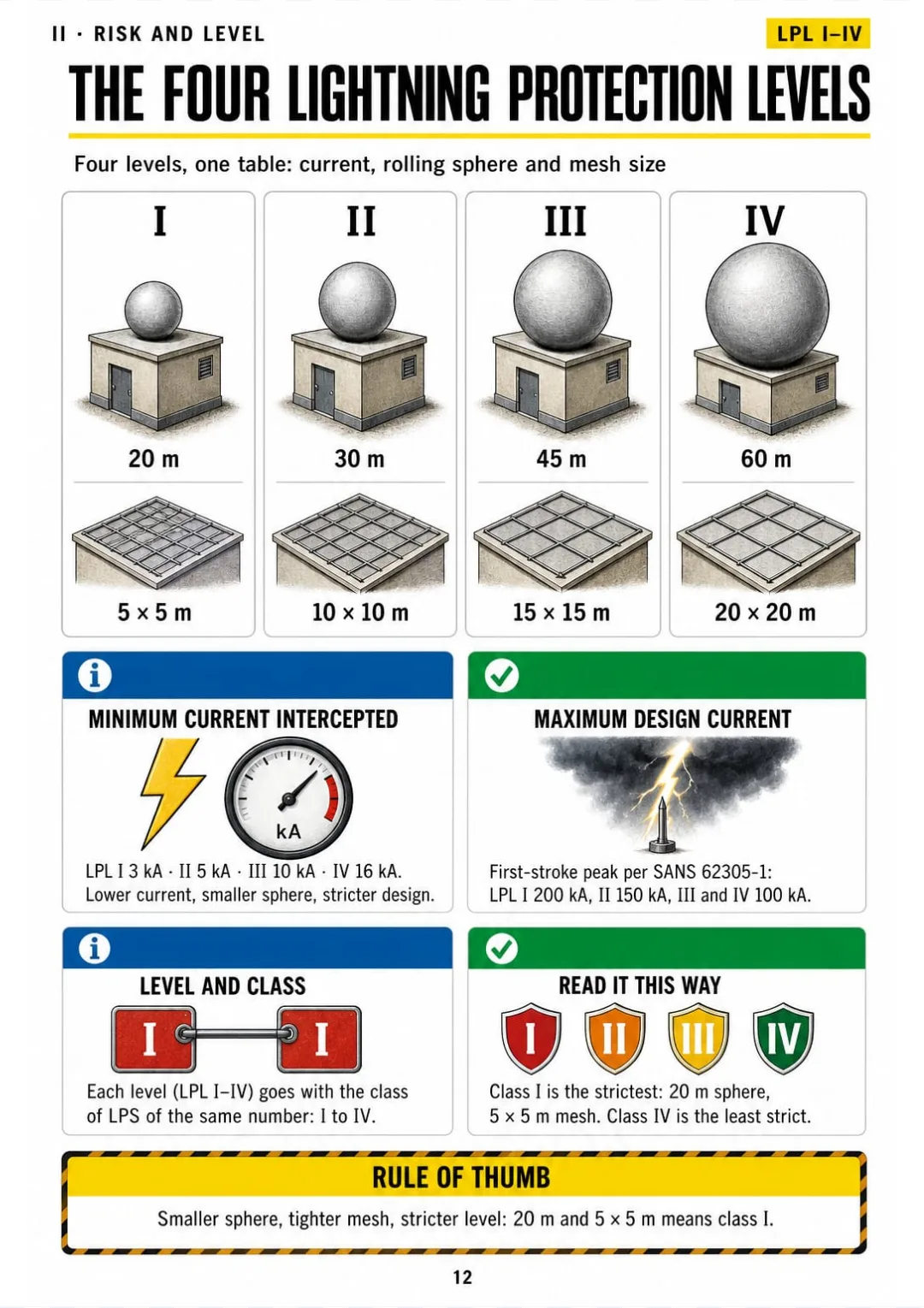
Why the risk assessment comes first, the four protection levels, collection area, surroundings, what thatch changes and a worked example on a lodge in Mpumalanga.
Rolling sphere, protection angle and mesh methods, air rods, natural components, rooftop aircon, solar and antennas, and conductor materials and sizes.
Why thatch needs its own design, the isolated mast, mast height and protected zone, separation distance, foundations and stays, lapas and rondavels, services and how to explain it to the owner.
What a down conductor must do, how many and how far apart, routing, bends and loops, fixings and clamps, natural down conductors, the test joint and keeping people safe nearby.
What the earth electrode does, Type A and Type B, rod length and spacing, soil resistivity, rocky ground and dry seasons, joining earths, corrosion and what the 10 Ω target means.
Equipotential bonding in one drawing, bond or separate, Type 1, 2 and 3 surge protective devices, short leads, overhead lines on farms and lodges, and who does what on the board.
Safety before any test, the roof-to-earth walk-round, when to inspect, continuity testing, the fall-of-potential test, reading the tester, why a reading is high and how to record results.
The whole system on one page, a thatch roof checklist, frequent installation mistakes, questions clients ask and a pre-storm-season job card.
At the end of the book: The whole system on one page, a thatch roof checklist, frequent mistakes, questions clients ask and a pre-storm-season job card.
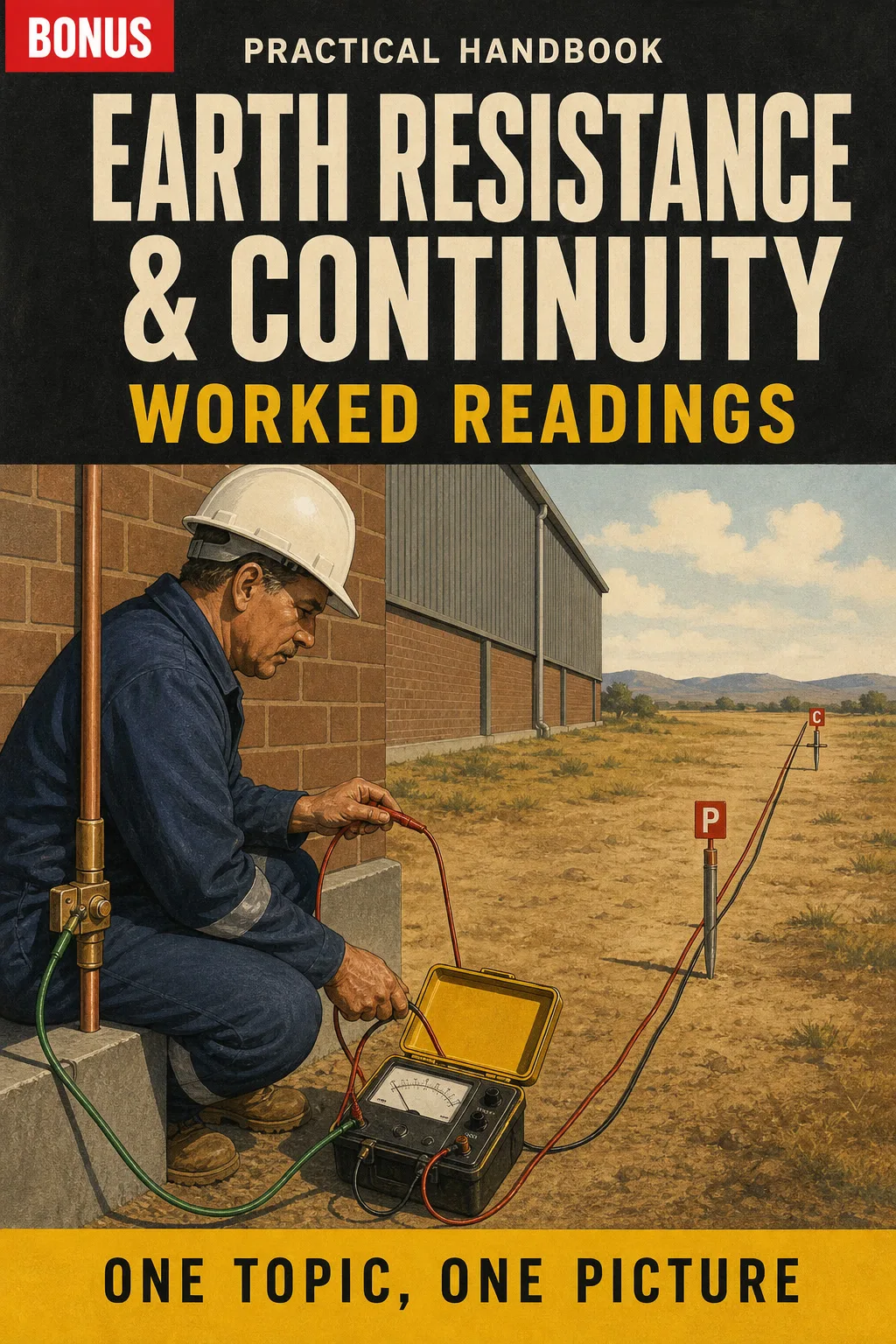
Practise on real-style readings: probe positions, results and what to do next, so you know how to read the meter before you are on site.

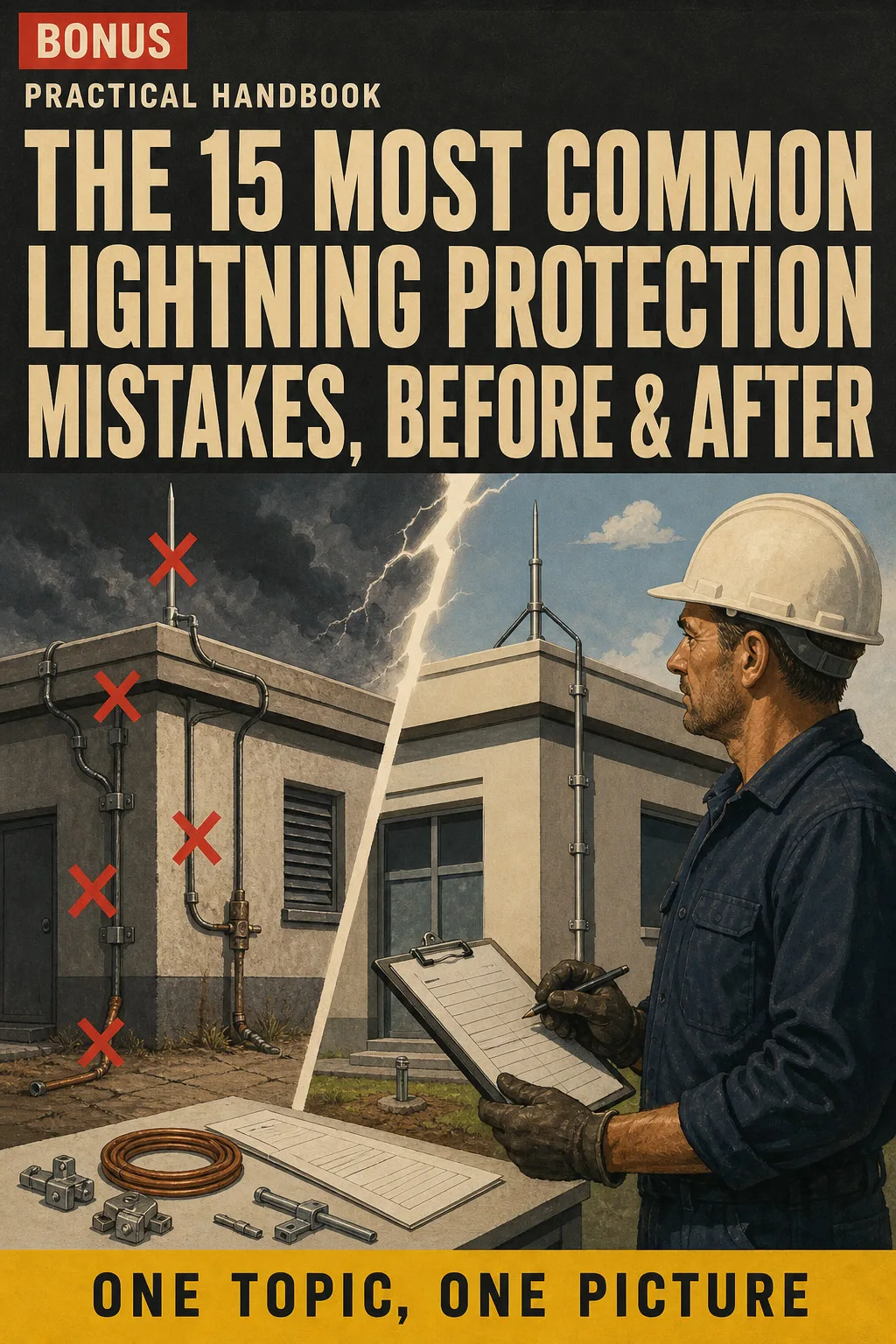
See the frequent errors drawn next to the correct version (masts too close to the thatch, missing bonds, loose clamps) and spot them in seconds on your next inspection.
📄 This is a digital PDF book sent to your email: nothing is printed or shipped.
PDF by email: We email you Lightning Protection Illustrated as a PDF, together with the two free books. It's a single payment: no installments, no extra charges.
You see the whole system in the order the strike travels, from air terminal to electrode, so you can price and plan the job knowing what goes where.
You walk the system from roof to earth in the same order every time, with each check drawn, and you know what the inspection should cover before you sign off.
You put the numbers behind what you do by hand: thatch separation, spacing, bonding sizes and probe positions, ready to explain to any client.
📄 This is a digital PDF book sent to your email: nothing is printed or shipped.
Try Lightning Protection Illustrated for 30 days, bonus books included.
We refund everything if the file won't open, if the book isn't what you see here, if you were charged twice or if the email doesn't arrive. Just email us.
You pay once. No subscriptions.
Yes. It won't teach you to pull cable. It's about the decisions: protection level, rolling sphere, down conductor spacing, bonding and earth testing, with worked examples in metres and ohms. Thatch has a whole part of its own: isolated masts, separation distance, stays, lapas and rondavels.
It is checked against SANS 10313, the SANS 62305 series and SANS 10142-1, with the Occupational Health and Safety Act 85 of 1993 for safety. Always confirm values against the current edition of each standard.
No. It's an independent illustrated book. It is not published, approved or endorsed by the SABS, the Department of Employment and Labour or any South African authority.
No. It helps you understand and organise the work, but it doesn't replace formal training, the standard or a site-specific design, and it doesn't come with a certificate or count towards any registration. Work on high-voltage and live systems is for qualified, authorised personnel only.
No. The readings and examples are written for this book so you can practise reading the tester. They are not official records or questions from any assessment.
The book and the 2 bonus books arrive as PDFs by email, at the address you enter at checkout.
No. It's a one-off payment, with no subscription.
Yes. It's a PDF you can print at home or at a print shop and take to site.
You have 30 days. We refund everything if the file won't open, if the book isn't what you see on this page, if you were charged twice or if the email doesn't arrive: just email us.
No more rereading the standard and finding nothing stuck.
The gap between mast and thatch: you see it drawn, and that's it.
You get to site knowing where everything is.
Drawings make studying faster.
The book is right below.
One-time payment: US$ 27 · Guarantee: 30 days · PDF by email
YES, I WANT LIGHTNING PROTECTION ILLUSTRATED FOR US$ 27📄 This is a digital PDF book sent to your email: nothing is printed or shipped.